May 25, 20269 min read
MVP 101: The Art of Building a Minimum Viable Product
Most of tech projects fail because they build too much without validation. Here's why MVP thinking is the most underrated skill in product development — and a practical framework to apply it.
66%.
According to the Standish Group's Annual CHAOS 2020 report, 66% of technology projects based on the analysis of 50,000 projects globally ended in partial or total failure. And if you think that only applies to large, complex projects, you definitely need to think again.
And here's another interesting number: According to an article I found at Beta Breakers, 45% of features built in software projects are never used.
That's close to half the work your team is doing. Half the sprints, half the code reviews, half the design iterations. All that for features that nobody even uses.
So what's going wrong? In most cases, teams are building without validating. They're solving problems that may not be real, for users they haven't clearly defined, with features nobody asked for.
This is where 'MVP thinking' changes everything.
What is an MVP?
Eric Ries, in The Lean Startup, defines it simply:
"The smallest thing you can build to validate a real idea with real users — and learn fast."
But let's break it down:
- Minimum — Only what's essential to solve the core problem, nothing extra.
- Viable — Good and stable enough for real users to actually use it. Not a broken solution.
- Product — Something shippable. Not a wireframe. Not a pitch deck. Something real.
It sounds simple enough. But the concept is widely misunderstood, and that misunderstanding is what causes most MVPs to fail before they even begin.
What an MVP is NOT
Let's get the misconceptions out of the way:
-
It's not a prototype or mockup. A prototype is something you test internally. An MVP is something real users interact with in the real world.
-
It's not an excuse to ship broken software. "MVP" does not mean "low quality." It means intentionally scoped. Quality still matters, you will not decrease the level.
-
It's not "build fast and fix later." The right approach is to build intentionally small, then learn and improve from real feedback from real users.
-
It's not the final product. The MVP is the starting point for learning what to build next. It is definitely not the end.
Why MVP Thinking Matters
Think about some of the biggest product failures in recent memory;
- Mixer - "Citing a poor market share and inability to scale in comparison to competing services, Microsoft announced that Mixer would be shut down."
- Google Wave - "The product lacked focus, which meant that most users were confused about what they were supposed to do with it."
- Nokia N-Gage - "It wasn't exactly the worst Nokia phone, but for a communications device with dedicated gaming hardware, it wasn't such a stellar attempt either."
- Hailo - "The way it works in New York is a little bit different. In Manhattan there are only yellow cabs, so people don’t need an app to hail yellows because they are available."
These products weren't built by incompetent and weak teams. They were built by strong, smart, well-funded people. And they all failed for the same reason: they built without validating properly.
Without MVP thinking, teams can face issues like:
- Months of development time spent on features nobody really wants or asked for.
- Failing to capture the right market because they chased the wrong problem.
- Budget overruns in hunt of the "perfect" version which never ships.
I am not saying every MVP will end up in success. It can be a failure, a disaster but with MVP thinking, even if the product ultimately fails, the damage is limited. You learn faster, spend less, and pivot with evidence rather than assumptions. As I always say in sessions I've run on this topic: the MVP is not a shortcut. It is how you avoid building the wrong product.
Real-World MVPs That Worked
Before diving into the framework, it helps to remember that some of the biggest products today started as the most minimal versions of themselves.

Airbnb simply started as a website where two random guys rented out air mattresses in their apartment to host tenants. No fancy booking system, no host verification, no fancy mobile app. Just a basic site and a real problem, which was finding affordable accommodation during peak events.
Amazon also launched as an simple online bookstore. Not a marketplace. Not AWS. Not Amazon Prime. Big JB (lol 😂) picked the narrowest possible category and validated that people would buy things online, and expanded from there.
Neither of them built everything first. They built the minimum, learnt what really worked, and grew from real user behaviour.
My own MVP 'Framework'
From what I have learnt so far building MVPs, I came up with the following framework. This IS NOT the only way and this can be very general, all I did was list down the steps that I have taken while building MVPs. Here's how to approach it:
1. Identify the Problem
Before anything else, ask: what pain point are we solving?
- Is it real?
- Does it happen repeatedly?
- Is it worth solving?
The intial instinct is to jump to solutions straight away. Do not do it. Don't build a solution while looking for a problem.
You can identify the problem by:
- Run stakeholder and end-user interviews.
- Study the existing user flow.
- Understand what actually happens today when the problem occurs.
2. Define Your Target User
"Everyone" is not a user. The narrow your user definition is, the better your decisions will be.
- Find the people most affected by the problem.
- Build user personas and map their current journey.
And at the end, you should be able to produce one clear sentence that defines exactly who you're building for. A vague user definition leads to vague features, vague priorities, and eventually a vague product that nobody connects with.
3. Map the Core User Journey
If a user could do exactly one thing with your product, what would it be? That has to be your core functionality. Everything else is a bonus at this point.
This step forces proper clarity. It's easy to list 20 things users might want. It's much harder and much more valuable to identify the single most critical thing they need to do. That one flow is what your MVP must be built upon and it must execute flawlessly.
4. Prioritize Features
Once you have a list of features, you need to cut it. Not cutting literally, you need to decide on what you will be handling first. You can do this by prioritizing. There are many ways you could prioritize your backog:
- MoSCoW.
- RICE scoring (Reach, Impact, Confidence, Effort).
- Eisenhower Matrix (Urgent vs. Important).
The MoSCoW method is what I personally follow and it is quite reliable and easier to get the hang of:
| Priority | What it means |
|---|---|
| Must Have | Non-negotiable. The MVP breaks without these. |
| Should Have | Important, but the MVP can launch without them. |
| Could Have | Nice to have if time and budget allow. |
| Won't Have (yet) | Explicitly out of scope for v1. |
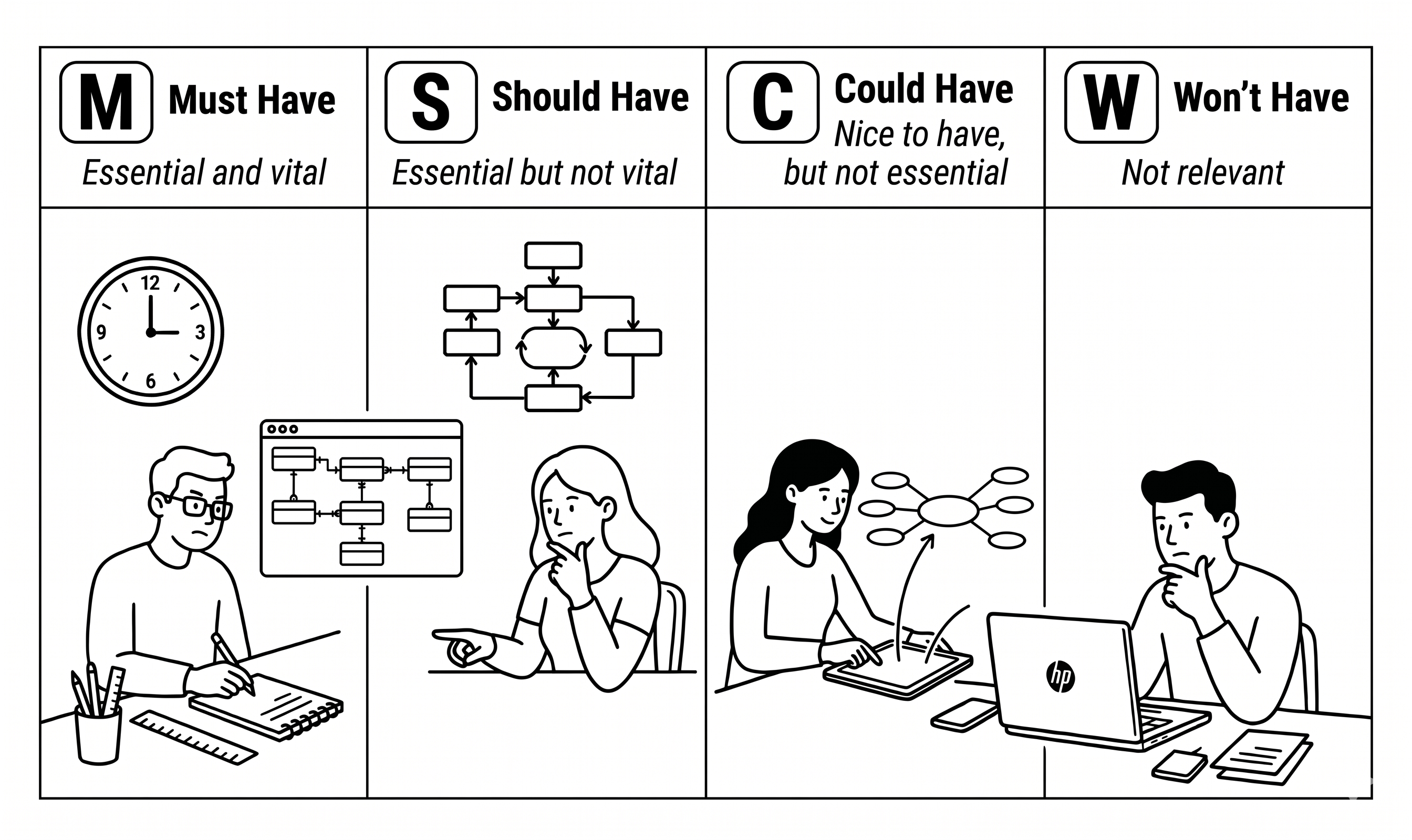
Putting something in the "Won't Have" column does not mean that it should not be considered at all. It's the difference between shipping an MVP and spending six months building a product nobody validates until it's "finished."
5. Define Your Success Metrics
How will you know if the MVP is working?
Before you launch, define what success looks like. Google's HEART framework is a useful structure that you can follow:
- Happiness — Are users satisfied? (NPS, feedback ratings)
- Engagement — Are users coming back? (session time, conversion rate)
- Adoption — Are new users finding value? (installs, signups, logins)
- Retention — Are users returning to achieve their goal? (DAU, WAU, MAU)
- Task Success — Are users completing the core journey? (error rate, drop-off %)
Without pre-defined metrics, "success" can become moving target, fluctuating often and every stakeholder has a different definition of it.
6. Build
Now you build. But remember what you're building and why. Launch the minimum and observe real behaviour. Let your validation and research decide what comes next. Resist the temptation to add "just one more feature" before launch. That is how MVPs become bloated products that took a year to ship.
7. Improve
The MVP launched. Now what? You listen to the real feedback from real users in the real world.
Then you groom your backlog based on what you have learnt. Reprioritize (Go back to step 4) and build what matters next. This is the cycle that separates products that grow from products that stagnate.
Common MVP Mistakes
Even with a clear framework, teams get it wrong. Here's what to watch for:
- Building too much before validating anything — The longer you build without user feedback, you're building on assumptions that can be completely wrong.
- Skipping user research and assuming you know best — You are not your user. The fastest way to build the wrong thing is to assume you already understand the problem.
- Treating the launch as the finish line — Launch is where the learning begins, not ends.
- Confusing MVP with "low quality" or "cheap" — Minimum scope, maximum quality within that scope.
- Letting scope creep kill the "minimum" in MVP — Every "small addition" someone advocates for before launch is a risk.
Key Takeaways
-
MVP is a mindset. It's not just a phase in your roadmap — it's how you approach every decision about what to build. Every feature, every sprint, every release can be evaluated through this lens: is this the minimum we need to validate the next thing we want to learn?
-
Build to learn. Every release is a question. What do users actually do with this? Let their behaviour answer — not your instincts, not the loudest stakeholder in the room, not the most confident engineer on the team.
The teams that ship fast and improve consistently aren't cutting corners. They're making better decisions, earlier and efficiently. That's what MVP thinking gives you.
If you're curious about MVPs and you are in the process of building one and if you're having any questions, feel free to reach out. I will be happy to share my experiences and offer help anyway I can.